
Basilica of Santa Maria Novella: Tickets and Info
This website offers official tickets for this venue. Please note, however, that it is not the official website of the venue.

Smartphone tickets

Priority Access Available

Instant confirmation

Flexible cancellation
Smartphone tickets
Why wait?
Instant confirmation
Flexible cancellation
Santa Maria Novella + Video Guide
Highlights
Avoid queues and enter Santa Maria Novella directly.
Explore the basilica’s remarkable art and architecture from the Middle Ages and Renaissance eras.
Listen to an audio guide available in English and four other languages.
Marvel at notable frescoes, cloisters, and Gothic design within the basilica.
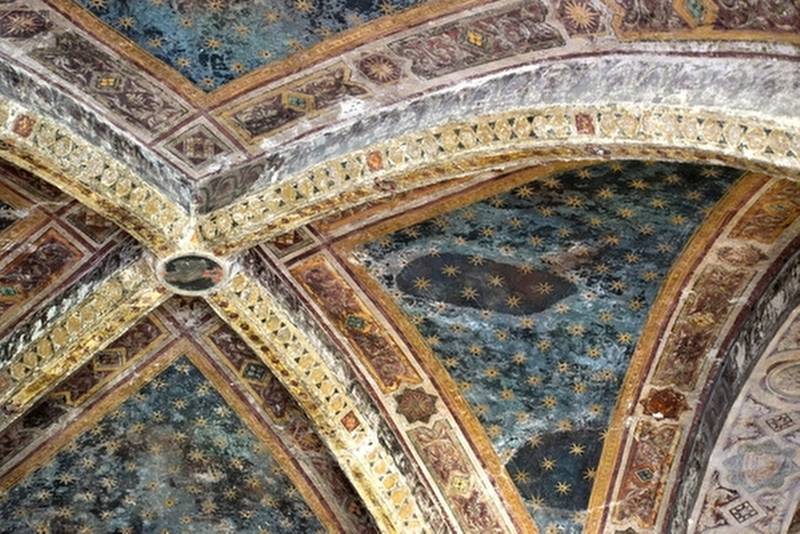
Discover historical decorations related to the 1348 plague.
Basilica of Santa Maria Novella
Discover the Basilica of Santa Maria Novella, a masterpiece of Florentine Gothic architecture rich with history and artistic treasures. Nestled in the heart of Florence, this iconic landmark offers visitors a unique glimpse into Renaissance art and culture. Plan your visit today and secure your tickets to explore its stunning frescoes, intricate chapels, and serene cloisters. Buy your tickets now to experience the timeless beauty of Santa Maria Novella.
About the Basilica of Santa Maria Novella
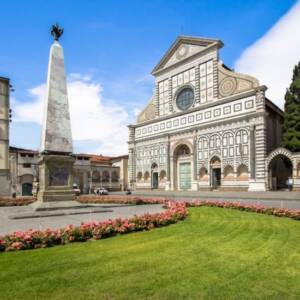
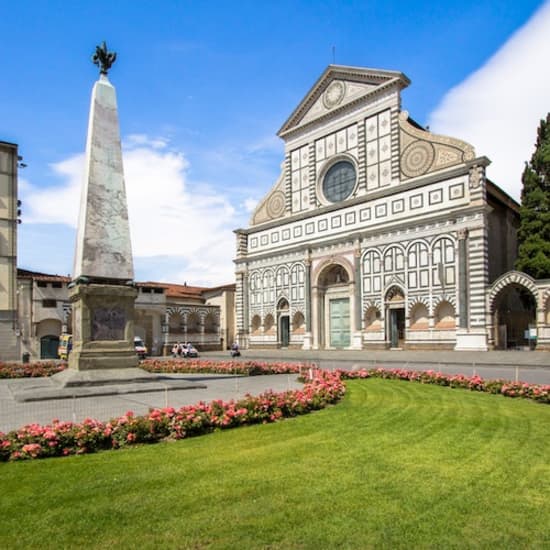
The Basilica of Santa Maria Novella is one of Florence’s most significant religious and architectural landmarks, serving as the city’s primary Dominican church for over eight centuries. Built upon the site of a 9th-century oratory, the current structure represents a masterclass in the transition from Gothic to Renaissance styles, most notably through its iconic marble facade designed by Leon Battista Alberti.
Beyond its architectural grandeur, the complex functions as a profound repository of art, housing seminal works by masters such as Giotto, Masaccio, and Ghirlandaio that fundamentally shaped the course of Western art history. Today, the monumental complex includes the church, the historic cloisters, and a museum that together chronicle the spiritual and cultural evolution of Florence from the Middle Ages through the Renaissance.
Architectural Styles: Italian Gothic and Renaissance
Annual Visitors: More than 500,000
UNESCO World Heritage Site: Included as part of the Historic Centre of Florence (since 1982)
Why Visit the Basilica of Santa Maria Novella?
The Birthplace of Renaissance Perspective
The basilica houses Masaccio’s Holy Trinity, a revolutionary fresco that marked the first systematic use of linear perspective in Western art. Visitors can witness the exact point where Brunelleschi’s mathematical principles were first applied to painting, forever changing how depth is perceived on a flat surface.
Masterpieces by Ghirlandaio and Giotto
The Tornabuoni Chapel contains a celebrated fresco cycle by Domenico Ghirlandaio, which offers a detailed visual record of daily life and fashion in 15th-century Florence. Additionally, the nave features Giotto’s towering Crucifix, an early 14th-century masterpiece that moved away from Byzantine stylization toward a more human, naturalistic representation of Christ.
Leon Battista Alberti’s Harmonious Facade
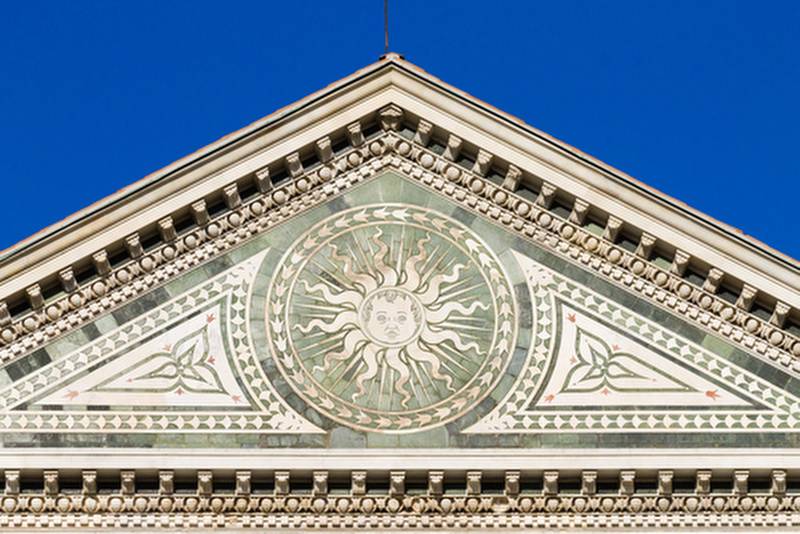
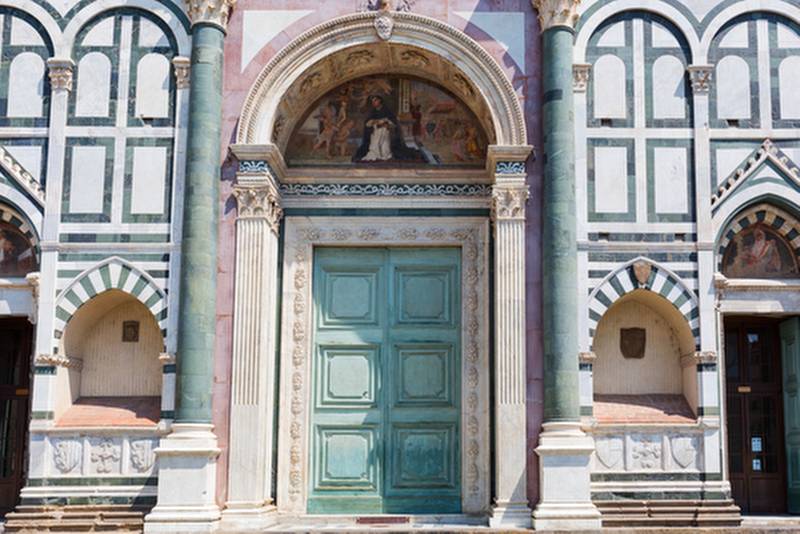
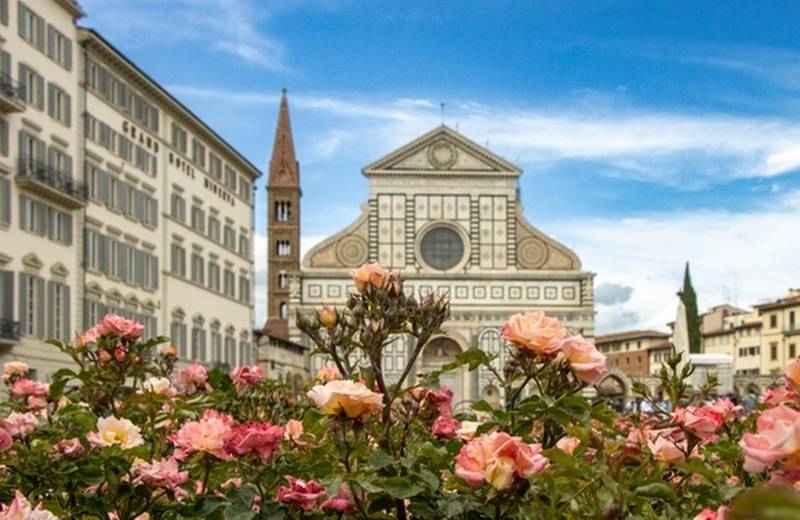
The exterior of the church is one of the most important examples of Italian Renaissance architecture. Designed by Leon Battista Alberti in the mid-15th century, the green and white marble facade perfectly blends Gothic elements with classical proportions based on strict geometric ratios.
The Historic Dominican Cloisters
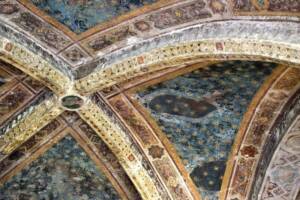
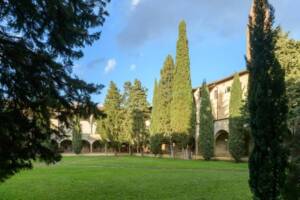
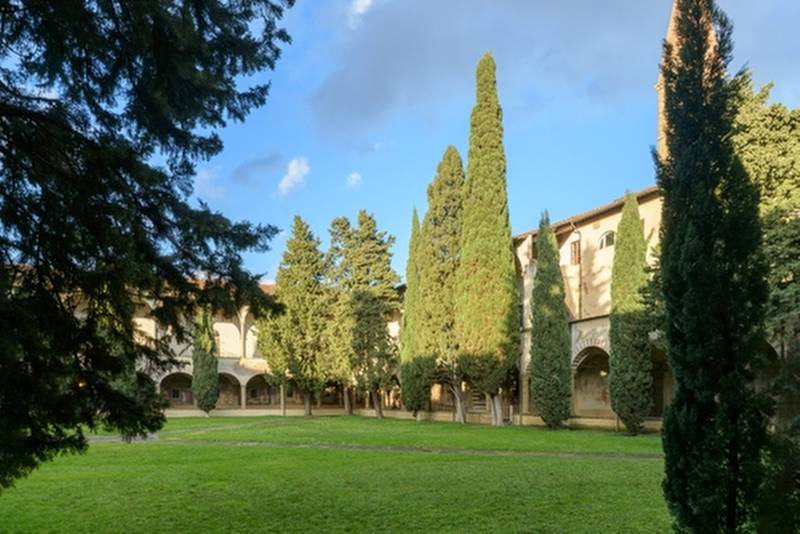
Beyond the main altar lies a vast monastic complex, including the Green Cloister and the Spanish Chapel. These spaces are decorated with complex allegorical frescoes that served as the spiritual and intellectual heart of the Dominican Order in Florence for centuries.
A Legacy of Science and Astronomy
The basilica is not only a religious site but also a historical scientific observatory. During the 16th century, the astronomer Ignazio Danti installed an armillary sphere and a gnomon on the facade to calculate the spring equinox, played a crucial role in the reform of the Julian calendar into the Gregorian calendar we use today.
Timings
The Basilica of Santa Maria Novella follows a specific schedule that varies according to the day of the week and the religious calendar.
Monday to Thursday: 9 AM – 5:30 PM
Friday and Civil Holidays: 11 AM – 5:30 PM
Saturday and Days before Religious Holidays: 9 AM – 5 PM
Sunday and Religious Holidays: 1 PM – 5 PM
Last Admission: Entry to the Santa Maria Novella Complex, including the Basilica, Museum, and Cloisters, is permitted until one hour before the scheduled closing time.
Specific Religious Holidays: The Sunday schedule applies to January 1, January 6, August 15, November 1, December 8, December 25, and Holy Easter.
Closures: The complex is closed to visitors and open only for prayer on Good Friday and Holy Saturday.
Public Holidays: These follow the timetable of the specific day of the week on which they occur.
How Do I Get There?
The Basilica of Santa Maria Novella is situated in the heart of Florence’s historic center, directly overlooking the piazza of the same name. Its central location makes it one of the most accessible cultural sites in the city.
Address:
Piazza di Santa Maria Novella, 18 50123 Firenze FI, Italy
- By Train
- By Tram
- By Bus
- By Car (and Parking)
The basilica is located less than a five-minute walk from the Firenze Santa Maria Novella (SMN) railway station, the primary rail hub for Florence.
Upon exiting the station from the main concourse, head toward the taxi stand and cross the street at the pedestrian lights.
The rear of the complex is immediately visible, and a short walk around to the front will lead you to the main entrance in the piazza.
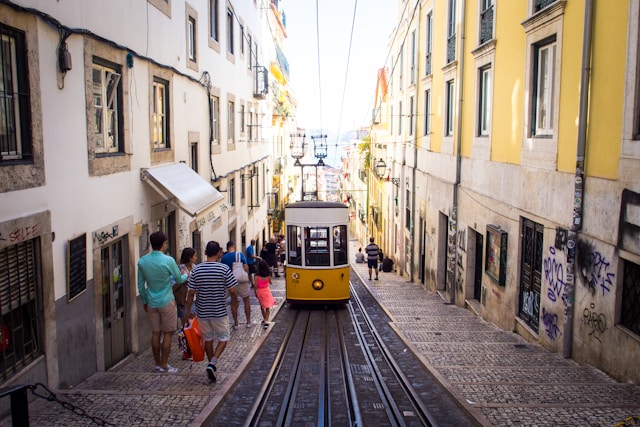
Florence’s modern tramway system provides a direct link to the basilica from the airport and suburban areas.
Line T1: Disembark at the Alamanni-Stazione stop, located on the side of the train station.
Line T2: Disembark at the Unità terminus, which is positioned just steps away from the piazza.
Numerous city bus lines operated by Autolinee Toscane stop within the immediate vicinity of the basilica.
Major lines including the 6, 11, and 12, as well as the small electric “C” lines (C2 and C4) that navigate the historic center, have stops near the station or the piazza.
Tickets should be purchased in advance at local tobacco shops (tabacchi) or via the official app and must be validated upon boarding.
The basilica is located within a Limited Traffic Zone (ZTL), where unauthorized vehicle entry is monitored by cameras and subject to fines. If you are driving, the most convenient option is the Parcheggio Stazione Santa Maria Novella, a large underground car park located directly beneath the train station.
Alternatively, travelers can use the “Park and Ride” facility at Villa Costanza, located off the A1 motorway. From there, you can park your vehicle outside the city and take the T1 tram directly to the basilica area in approximately 20 minutes.
Things to Know Before Visiting the Basilica of Santa Maria Novella
Admission tickets include access to the entire monumental complex, including the Basilica, the Cloisters, and the Museum.
Visitors must dress appropriately for a place of worship, ensuring that shoulders and knees are covered before entering.
Large bags, hiking backpacks, and bulky luggage are not permitted inside and must be stored in the designated cloakroom.
The ticket office stops issuing entries 60 minutes before the site’s scheduled closing time.
Flash photography and the use of tripods or professional filming equipment are strictly prohibited to protect the frescoes and artworks.
While the complex is open to the public, tourist visits are suspended during the celebration of Mass and other religious services.
It is advisable to book tickets in advance online to secure a specific entry time and avoid long queues at the physical ticket window.
Mobile phones must be switched to silent mode, and visitors are expected to maintain a quiet demeanor throughout the sanctuary.
The historic stone flooring can be uneven in certain sections of the cloisters, so wearing sturdy walking shoes is highly recommended.
Guided tours and audio guides are available at the entrance for those who want a detailed historical context of the Dominican influence on the site.
Additional Information
- Facilities
- Souvenir Store
- Dining
The Basilica of Santa Maria Novella provides essential amenities to ensure a comfortable visit.
Public restrooms are located within the museum complex and are maintained regularly; however, visitors should note that facilities may be limited during peak hours.
A designated cloakroom or storage area for large bags and umbrellas is available, as bulky items and large backpacks are not permitted inside the sanctuary or the cloisters for security and conservation reasons.
Information points are situated near the entrance where visitors can obtain site maps or rent multilingual audio guides.
These guides provide in-depth commentary on the architectural history and the specific artworks within the chapels.
While the complex is centrally located, it is primarily an open-air and historical stone structure, so visitors are encouraged to carry water and wear comfortable walking shoes.
The official bookshop is located near the exit of the museum circuit.
It offers a curated selection of high-quality merchandise, ranging from detailed academic monographs and art history books to more accessible guidebooks available in several languages. Many of the publications focus specifically on the Dominican Order’s influence on Florentine art and the scientific achievements associated with the basilica.
In addition to literature, the store features items inspired by the artworks found within the complex, such as prints, postcards, and stationery. Visitors can also find traditional Florentine crafts and products, including scents and herbal remedies that nod to the historical pharmaceutical tradition of the neighboring Dominican friars.
The shop adheres to the same opening hours as the museum and accepts both cash and major credit cards.
While there is no cafeteria or restaurant located directly inside the Basilica of Santa Maria Novella, the surrounding piazza and the neighborhood of the train station offer an extensive variety of dining options.
Immediately outside the gates, visitors will find traditional Italian cafes and trattorias serving local Tuscan fare, as well as quicker options for sandwiches or gelato.
For a more historic experience, the world-famous Officina Profumo-Farmaceutica di Santa Maria Novella is located on the nearby Via della Scala and features a tea room within its historic halls.
Because the basilica is a religious site, consuming food or drink is strictly prohibited inside the church, the cloisters, and the museum galleries.
Visitors are encouraged to explore the many establishments in the square to enjoy a meal with a view of Alberti’s famous facade.
Accessibility
The Basilica of Santa Maria Novella has made significant efforts to ensure that the monumental complex is accessible to visitors with reduced mobility.
The primary entrance to the church from the piazza features ramped access, allowing wheelchair users to enter the nave without encountering steps.
Once inside, the majority of the basilica’s floor plan is level, providing an unobstructed view of the main altar, the Masaccio fresco, and the various side chapels.
Access to the monastic cloisters and the museum areas is facilitated by a series of internal ramps and a lift system.
Specifically, the Green Cloister and the Great Cloister are largely accessible, though some original stone paving may be slightly uneven due to the age of the materials.
Visitors requiring the use of the elevator to reach upper levels or specific museum rooms are advised to speak with the staff at the ticket desk, who can provide assistance and guidance on the best routes to take.
For visitors with sensory impairments, the complex offers specific resources. There are tactile maps and relief models of the facade and certain artworks available to assist those with visual impairments in understanding the proportions and decorations of the site.
Service dogs are permitted within the complex, provided they are properly harnessed and have the necessary documentation. It is important to note that while the majority of the site is accessible, some narrow passages in the oldest parts of the monastery may remain difficult to navigate with wider electric wheelchairs.
Interesting Facts about The Basilica of Santa Maria Novella
The Basilica of Santa Maria Novella was the first great basilica built in Florence and remains the city’s principal Dominican church.
Leon Battista Alberti designed the upper part of the facade to harmonize with the existing medieval lower section using a perfect square as a geometric base.
The interior houses Masaccio’s Holy Trinity, which is considered the first painting in history to use consistent mathematical linear perspective.
Giotto’s Crucifix, hanging in the central nave, revolutionized art by depicting Christ with realistic weight and human suffering rather than a stylized divine form.
The astronomical instruments on the facade, including a marble gnomon and an armillary sphere, were used to prove the inaccuracies of the Julian calendar.
The Tornabuoni Chapel contains one of the largest fresco cycles in Florence, famously featuring portraits of the powerful Medici and Tornabuoni family members.
The Spanish Chapel was originally a chapter house but earned its name because it served as the place of worship for the Spanish retinue of Eleanor of Toledo.
The Green Cloister is named for the unique green earth pigment, known as terra verde, used by Paolo Uccello in his 15th-century frescoes.
The complex includes the oldest pharmacy in the Western world, which was founded by Dominican friars in 1221 to create herbal remedies.
Filippo Brunelleschi’s only wooden sculpture, the Crucifix in the Gondi Chapel, was created as a challenge to Donatello’s own artistic style.
The facade is one of the few in Florence that was actually completed during the Renaissance, unlike the Duomo or San Lorenzo which remained unfinished for centuries.
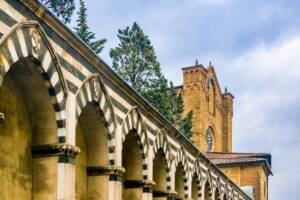
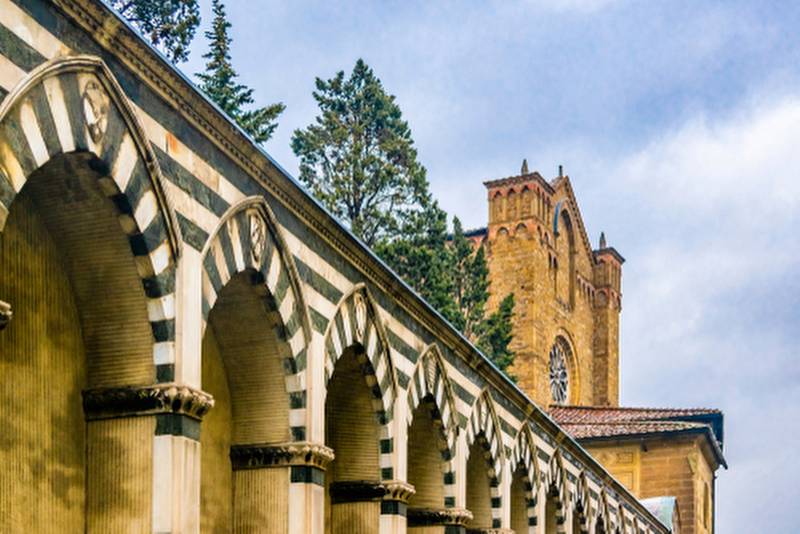
The “Avelli” are the blind arches along the side of the church and its enclosure that served as burial tombs for noble Florentine families.
Domenico Ghirlandaio’s workshop, which painted the main choir, was where a young Michelangelo began his apprenticeship as an artist.
The complex was built over the site of a 9th-century oratory known as Santa Maria delle Vigne because it was then surrounded by vineyards.
The Great Cloister is the largest in the city and was once used as a military training school during the 19th and 20th centuries.
 English
  Italiano
  Español
  Français
  Deutsch
  Português